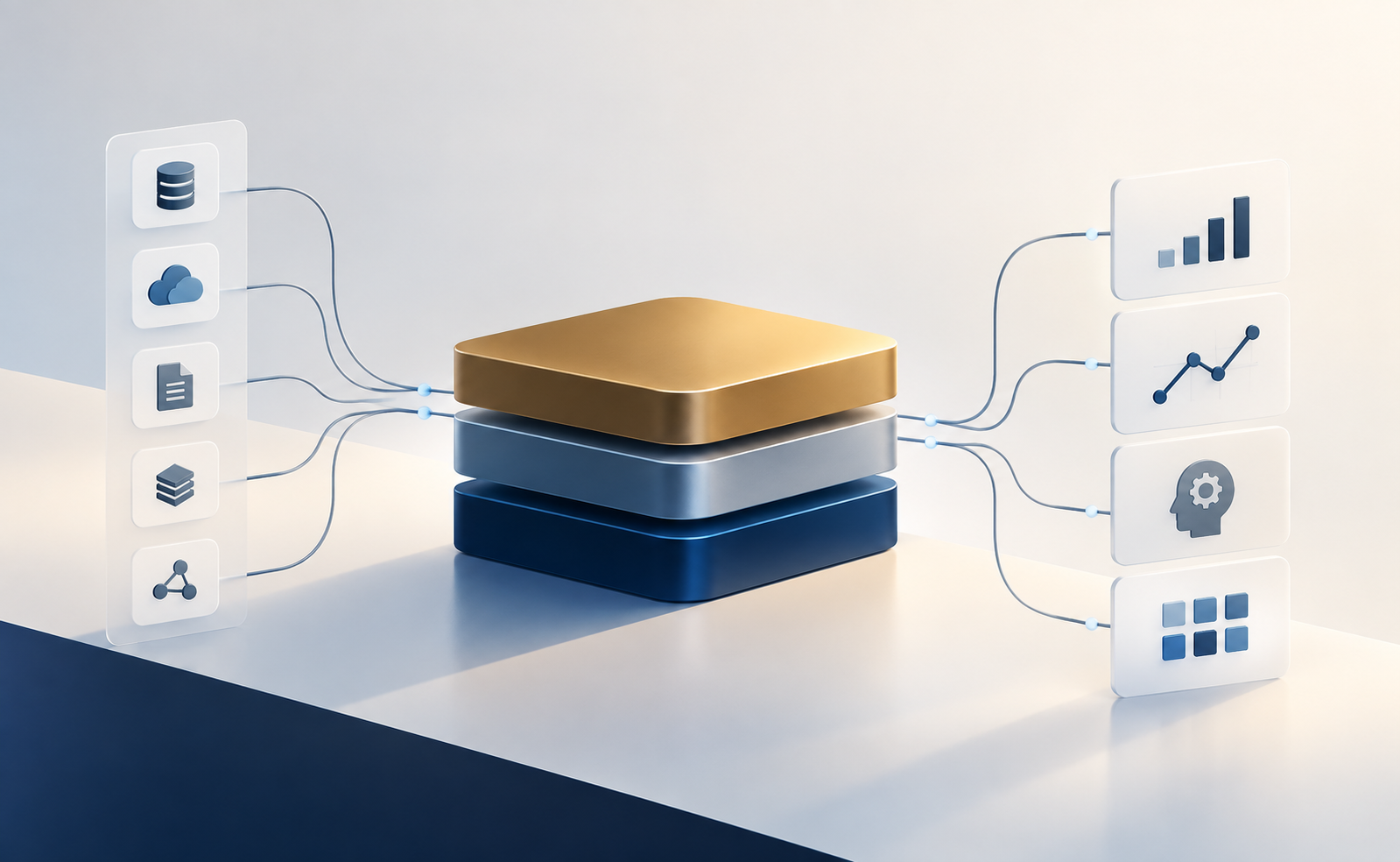
A practical architecture guide to orchestration, operational overhead, governance, scalability and cost
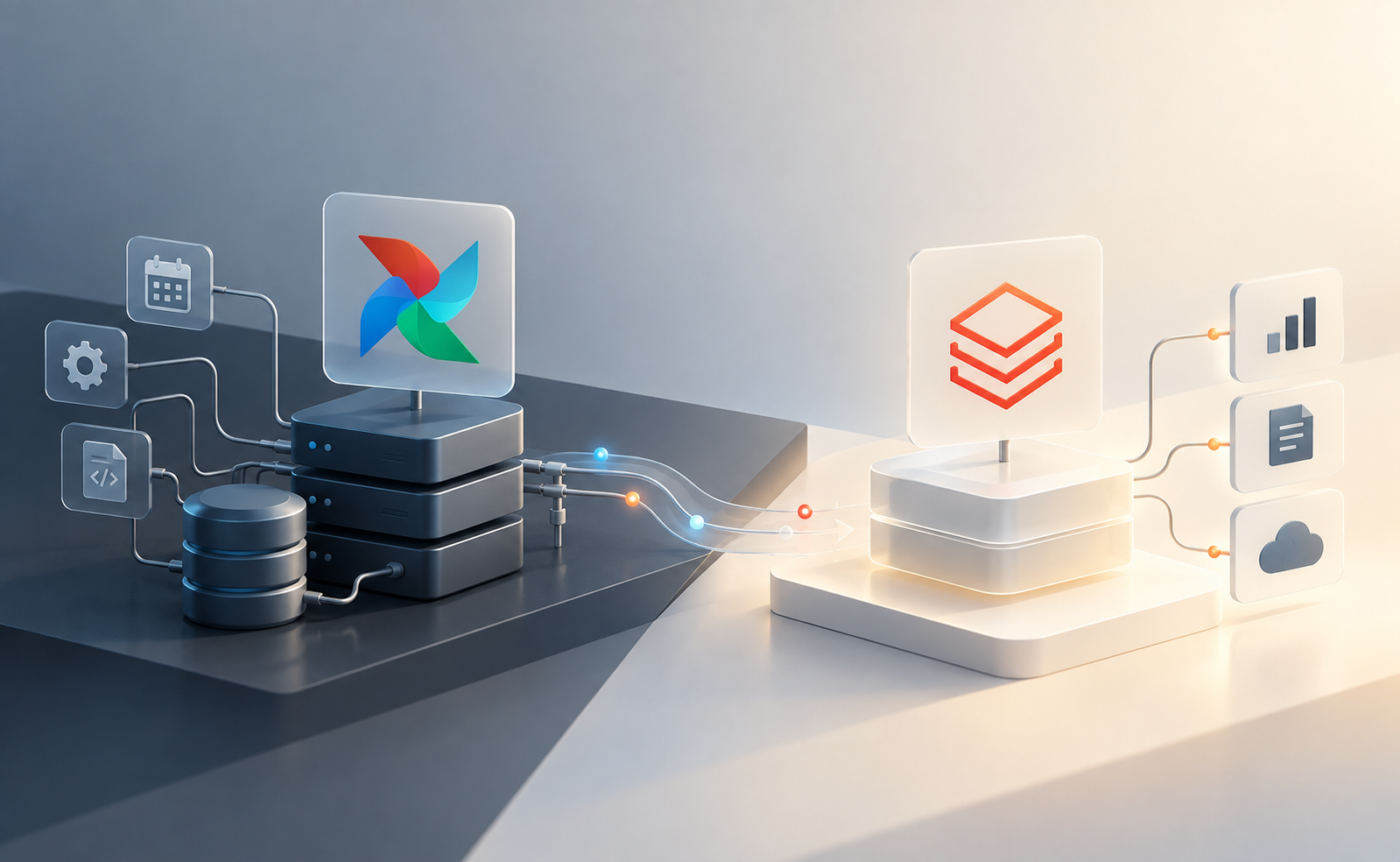
Airflow offers an independent, extensible workflow control plane. Databricks Lakeflow Jobs integrates orchestration directly into the data platform. The real question is: where do you want your engineering team to draw its operational boundary?
1. Orchestration Works. But What Does It Really Cost?
The visible part of orchestration is a workflow graph. The less visible part is the platform required to keep that graph reliable.
For a data engineering team, orchestration is not only a scheduling problem. Someone has to deploy or consume the orchestrator, manage dependencies, control access, monitor failures, scale execution and understand what happens when a workflow stops behaving as expected.
Apache Airflow and Databricks Lakeflow Jobs solve the same broad problem, coordinating tasks, but place responsibility in fundamentally different parts of the architecture. Airflow is an open-source workflow platform with components such as the scheduler, DAG processor, API server, metadata database and configurable execution. Lakeflow Jobs is a Databricks service for scheduling and orchestrating tasks, with integrated run monitoring and native support for Databricks compute.
Do you want orchestration to be a platform your team operates, or a managed capability embedded in the data platform you already use?
2. The Airflow Operating Model
Airflow is flexible because the deployment boundary is explicit.
Current Airflow 3 documentation describes a production architecture built from multiple components. The scheduler triggers task instances and submits ready work to the configured executor. The DAG processor parses DAG bundles and serializes DAGs into the metadata database. The API server provides the REST API and user interface. Airflow can be deployed simply or in a distributed environment.
Component Topology & Control Plane
DAGs / Code
Python DAG files, bundles, schedules, dynamic task definitions.
Scheduler + DAG Processor
Serializes DAGs, evaluates schedules, triggers tasks, dispatches to executor.
Metadata DB & API Server
PostgreSQL/MySQL state store, REST API, Web UI authentication and session store.
Worker / Task Runner
Celery/Kubernetes workers executing Python code and invoking external systems.
This does not mean every Airflow installation requires a large platform team. Airflow can run on a single machine for simpler deployments, and managed Airflow services can reduce the infrastructure burden. The important point is that self-managed Airflow has a real operational surface: installation, component deployment, metadata database management, upgrades, provider packages, resource sizing, monitoring and recovery.
Dependency management is another hidden cost. Airflow installations can extend their Python environment with providers, operators and plugins. That flexibility is useful for integrating with different systems, but it also creates a software lifecycle that needs controlled testing and deployment.
Deploy, configure, patch, upgrade, and recover Airflow components across control and data planes.
Choose and operate the executor, autoscale worker pools, and tune concurrency according to workload needs.
Manage provider packages, custom plugins, Python wheels, virtual environments, and avoid version clashes.
Observe scheduler heartbeat, DAG parsing latency, metadata lock contention, and queue queueing health.
3. What Changes with Lakeflow Jobs
Lakeflow Jobs moves much of the orchestration control plane into Databricks while keeping task execution tied to Databricks workloads.
Databricks documents Lakeflow Jobs as workflow automation for Databricks. A job contains one or more tasks, tasks can have dependencies and conditional logic, and triggers can be time-based or event-based. Jobs provide run history, task-level details, logs and notifications. Tasks can run notebooks, Python scripts, pipelines and other supported task types.
Databricks-Managed Orchestration Plane
Trigger (Time / Event)
Cron, table updates, file arrival, or API calls trigger the Lakeflow Job DAG and its associated task graph.
Lakeflow Job Engine
Fully managed scheduler, conditional task branching, automated repair/reruns, run history, and alerts.
Tasks & Unity Catalog
Notebooks, Python scripts, SQL, and DLT pipelines governed under Unity Catalog identities and system tables.
With serverless compute for workflows, Databricks states that users do not need to configure and deploy the underlying compute infrastructure; Databricks manages resources and automatically enables autoscaling and Photon for supported serverless workflows. Serverless workflows require Unity Catalog and compatible workloads.
That can reduce infrastructure work, but it does not eliminate engineering responsibility. Teams still need to design dependencies, choose appropriate compute, manage permissions, control retries, review failed runs and understand workload spend.
Managed orchestration reduces platform operations; it does not remove the need for sound workflow design, governance, cost controls or incident response.
4. Two Architectures, Different Responsibility Boundaries
The most useful comparison is not a feature checklist. It is a responsibility map. Airflow gives teams a broad orchestration control plane that can coordinate workloads across different environments. Lakeflow Jobs concentrates orchestration around Databricks workloads and services.
Apache Airflow
Team-Operated Control Plane
The engineering team owns or configures the control plane layers:
- Workflow code & DAG authoring
- Airflow cluster deployment & topology
- Scheduler & executor management
- Metadata database maintenance & tuning
- Providers, operators & custom plugins
- Runtime scaling & worker queue sizing
- Platform & scheduler health monitoring
Databricks Lakeflow Jobs
Platform-Managed Service
Control plane operations are delegated to Databricks:
- Workflow definition & task dependency graph
- Databricks-managed scheduling service
- Zero scheduler / metadata DB operations
- Built-in workspace security & Run-as context
- Task runtime choices & runtime policies
- Serverless compute option with auto-tuning
- Integrated run history, repairs & notifications
A responsibility map, not a scorecard: the right fit depends on workload boundaries and your organization's operating model.
| Dimension | Apache Airflow | Databricks Lakeflow Jobs |
|---|---|---|
| Orchestration | DAG-based workflow platform | Jobs, tasks and triggers inside Databricks |
| Control plane | Components are deployed/operated or managed-service based | Databricks-managed service |
| Compute | Depends on executor/deployment model | Job or serverless compute |
| Dependencies | DAG code, providers, plugins, environments | Job configuration and Databricks runtimes |
| Recovery | Workflow/task retry behavior | Task retries plus repair/rerun tooling |
| Monitoring | Airflow UI + platform monitoring | Run history, task details, logs, metrics, notifications |
| Governance | Depends on surrounding identity/security model | Job permissions, Run as, Unity Catalog |
5. The Hidden Costs Behind the Workflow Graph
A workflow can be visually simple while its operating model is not. The hidden cost is the engineering time and infrastructure required around the graph.
Infrastructure & Maintenance
With self-managed Airflow, the team owns the lifecycle of Airflow components and the supporting database and runtime environment. Official installation guidance places deployment, database setup, startup/recovery, maintenance, upgrades, monitoring and resource management in the operator's hands.
Dependency Management
Airflow's provider model makes integrations extensible, but providers and plugins become part of the software lifecycle. Version upgrades should therefore be treated as controlled engineering changes rather than a simple package update.
Scaling & Reliability
Airflow's scheduler can run in multiple instances for performance and resilience, and its performance depends on resources, DAG complexity, scheduler configuration and metadata-database behavior. Scaling is achievable, but it is an engineering concern that must be monitored.
Lakeflow Jobs changes these trade-offs. Databricks manages the orchestration service, and serverless workflows can remove the need to configure job infrastructure. At the same time, compute remains a real cost driver. Databricks provides system tables and job-cost monitoring so teams can attribute and investigate usage for jobs.
6. Cost: Look Beyond the Compute Bill
Orchestration cost has at least two layers: direct platform consumption and the human effort required to keep the platform reliable. A comparison based only on compute rates misses the second layer.
| Cost Area | Airflow | Lakeflow Jobs |
|---|---|---|
| Control plane | Deployment/managed-service dependent | Databricks-managed |
| Task compute | Executor and cloud compute design | Job/serverless compute |
| Operations | Component lifecycle is an explicit concern | More control-plane work is delegated |
| Dependencies | Providers/plugins/environments | Databricks task/runtime choices |
| Cost attribution | Monitor platform + execution resources | Job and billable-usage system tables |
| Optimization | Tune scheduler/executor/workers | Tune compute, serverless use and workflow design |
Databricks documents system tables and examples for monitoring Lakeflow Jobs and Pipelines. Supported job and serverless usage can be associated with job and run metadata, making cost analysis part of the platform's operational tooling.
Compare total operating cost, not just infrastructure price: Platform consumption + engineering operations + incident response + upgrade effort + governance effort.
7. Governance, Security and Observability
Governance exposes another architectural boundary. Airflow can be integrated with enterprise identity, secrets and monitoring patterns, but implementation depends heavily on the deployment and external systems being orchestrated.
Lakeflow Jobs has job-level permissions and a Run as identity. Databricks documents separate privileges for viewing, running and managing jobs, and recommends service principals for production jobs so workflow execution is not tied to an individual employee. When jobs access Unity Catalog-managed assets, the Run as identity's permissions are evaluated for those resources.
Observability differs in emphasis. Airflow teams typically observe workflow outcomes and the health of the Airflow platform. Lakeflow Jobs provides run history, task details, logs, metrics and notifications within Databricks, alongside job activity and billable-usage system tables.
The Two-Sided Boundary Rule
Whichever orchestrator you choose, monitor both sides of the boundary. A green orchestration run is not enough if the underlying data, external dependency or compute environment is unhealthy.
8. Practical Trade-offs
Airflow is often attractive when orchestration itself is a platform capability. Its open-source model, code-first DAGs and provider ecosystem can fit workflows spanning heterogeneous technologies where teams want direct control over the orchestration layer.
Lakeflow Jobs is attractive when Databricks is already the center of the data-processing architecture. The integration between jobs, tasks, Databricks compute, run monitoring and governance can reduce the number of platform boundaries an engineering team operates.
| Requirement | Architectural Question to Answer |
|---|---|
| Many technologies | Do we want one independent orchestration layer across all clouds and SaaS? |
| Less control-plane operations | Which operational responsibilities can be safely delegated to a managed service? |
| Databricks-native workflows | How much of our pipeline work already executes directly as Databricks tasks? |
| Infrastructure control | Do we strictly require direct control over the orchestration cluster runtime? |
| Cost visibility | Can workload costs be attributed clearly enough down to individual queries/jobs to optimize? |
| Governance | Where should identity, permissions, secrets and audit boundaries reside? |
9. When Each Approach Makes Sense
Workload Boundary & Operating Model Routing
Many External Systems
Workflows span multi-cloud services, on-prem databases, third-party APIs, and diverse non-Spark applications.
Mostly Databricks-Native
Core transformations, streaming, ML, and BI pipelines execute primarily inside the Databricks Lakehouse.
Need Direct Platform Control
Strict requirements to own executor runtimes, custom Python plugins, fine-grained queue balancing, and open code.
Want Less Infrastructure Setup
Desire serverless execution, automatic Photon scaling, and zero cluster provisioning overhead for jobs.
Architecture decision lens: use workload boundaries and operating-model requirements rather than a generic winner.
If most critical tasks already execute inside Databricks, keeping scheduling, task execution, monitoring and governance close to that platform can simplify the architecture. If orchestration must coordinate a wide set of external platforms and the organization deliberately wants an independent workflow control plane, Airflow may fit more naturally.
Hybrid architectures are also possible. An external orchestrator can trigger Databricks jobs while Databricks handles data-processing execution. This can preserve an enterprise-wide control plane while keeping Databricks-specific execution inside Databricks. The trade-off is another integration boundary to operate and secure.
10. Migration: Do Not Start with a DAG-to-Job Rewrite
Moving between the two is not primarily a syntax conversion. It is a dependency and responsibility migration.
Audit the Existing DAG Surface
Document scheduling complexity, custom plugins, database connections, and external dependencies.
Classify Tasks by Execution Engine
Identify Databricks-native compute tasks versus external SaaS systems and Airflow-specific providers.
Map Identities & Security Permissions
Establish service principals and Unity Catalog permissions before changing execution ownership.
Decouple Orchestration from Business Logic
Separate workflow orchestration glue from actual transformation and business algorithms.
Migrate a Representative Workflow End-to-End
Test full execution, edge-case failure triggers, and repair/rerun scenarios on a sample pipeline.
Compare Total Operating Effort & Run Costs
Measure engineering hours and billing footprint after migration rather than assuming instant savings.
Databricks supports UI, CLI, REST API and Declarative Automation Bundles (DABs) for job configuration and deployment. Failed or canceled jobs can be repaired and rerun from the Jobs tooling. These capabilities support controlled migration, but the target architecture still needs workload-specific testing.
11. The Abilytics Perspective
The real cost of orchestration is rarely visible in the DAG itself. It appears in the infrastructure that hosts it, the dependencies that keep it running, the engineers who upgrade it, the controls that secure it and the systems that explain why it failed.
Airflow and Lakeflow Jobs represent two legitimate operating models. Airflow emphasizes an independent, extensible orchestration platform. Lakeflow Jobs emphasizes managed orchestration integrated with the Databricks data platform. The architectural decision should therefore begin with responsibility boundaries, not product popularity.
At Abilytics, we see orchestration as part of the wider data-platform operating model. The right design is the one that makes workflow ownership explicit, keeps governance enforceable, makes costs observable and leaves engineers enough time to improve data products rather than continuously maintaining the machinery around them.
Need an objective assessment of your Airflow or Databricks orchestration architecture?
Consult Our Architecture Team